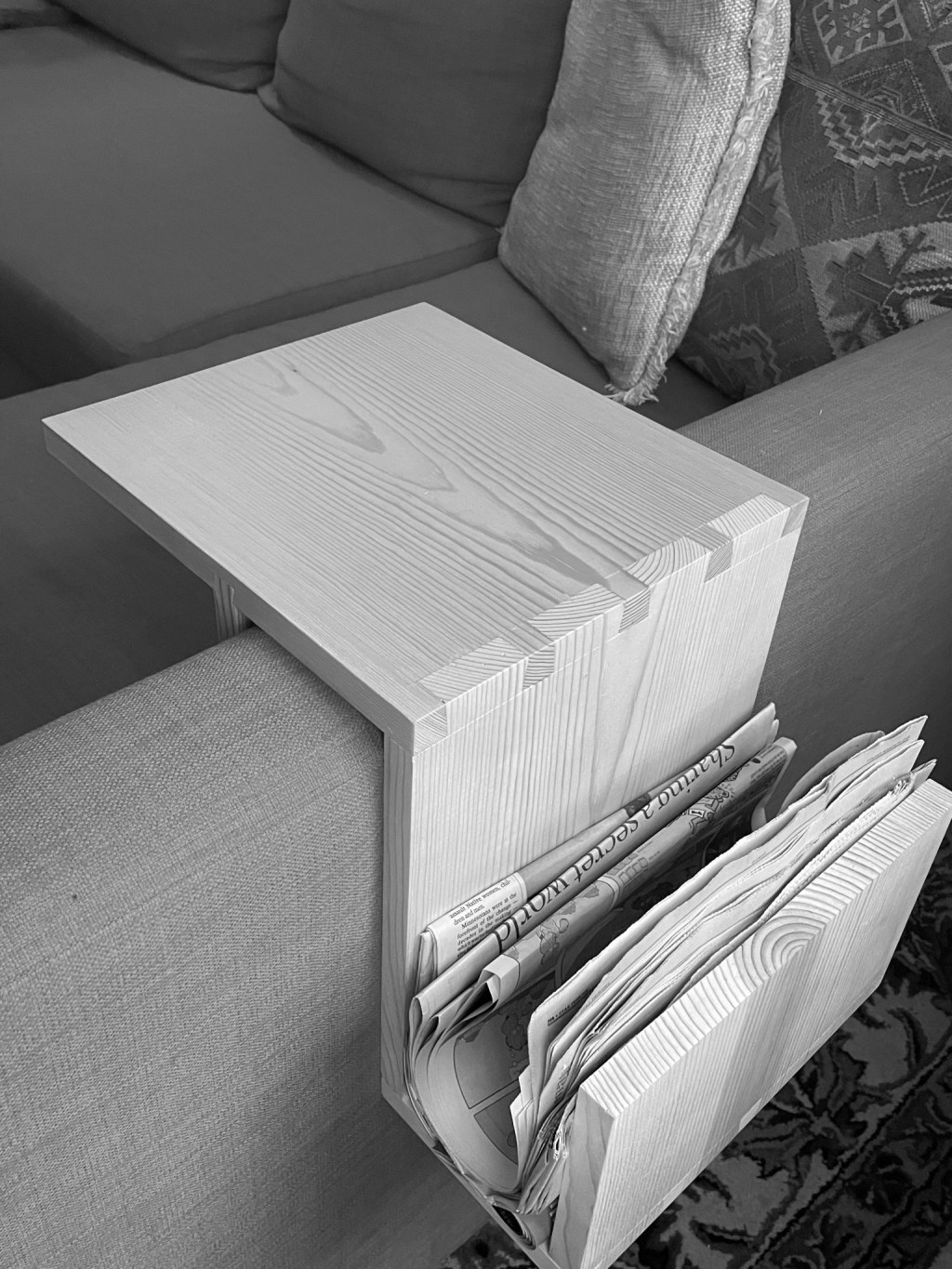
In our small living room, little space remains for setting drinks, books, or any other item requiring a semi-flat surface. What was needed? I had three goals in mind:
- Create a stable surface to support drinks, books, laptops, etc.
- Avoid floor-supported systems to prevent accidental spills from an over active dog.
- Provide additional storage for newspapers and books.
The result was an arm-supported, sliding shelf with an open pocket.
The project includes 5 offcuts of 1×12 pine. The offcuts from the office shelves project provided the perfect material to tackle this project. The specific lengths varied by what was on hand; mine all started at about 13″.
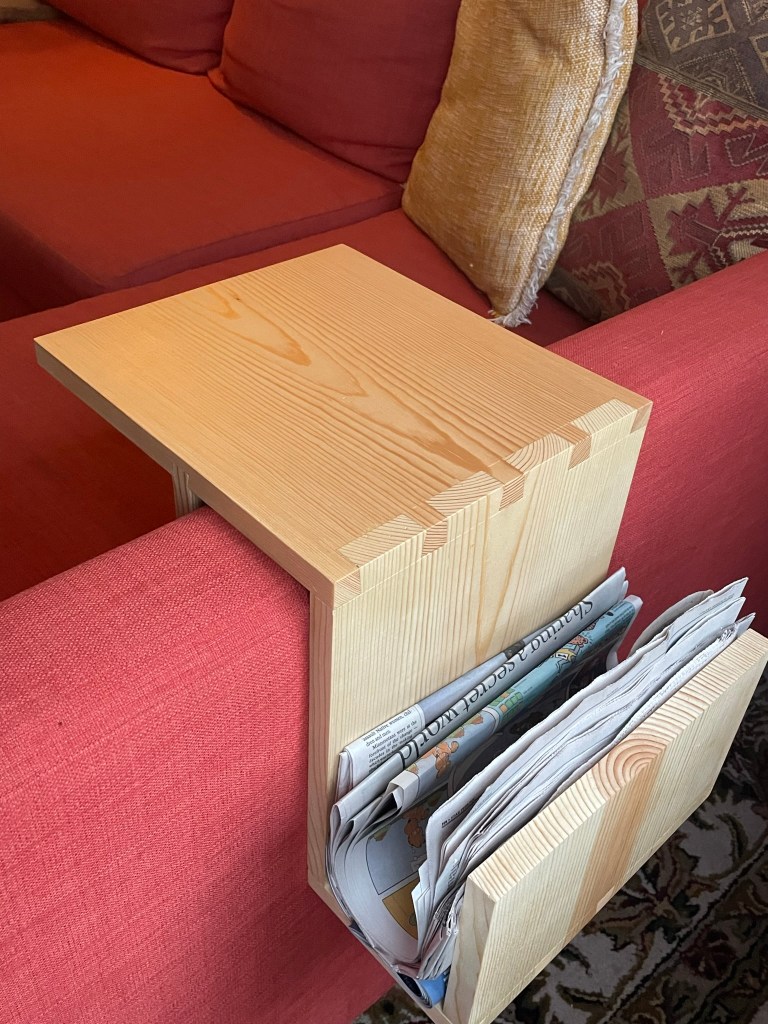
With all the pieces flat* and square, I first cut dovetails for the top, drop, and shelf joints.
(* As mentioned earlier, this is all milled lumber purchased from the home center. I don’t have a power planer, nor would a planer flatten this thin stock: pringles in, pringles out. As a result, the boards are all slightly cupped, but not so much that the cup cannot be held fast by the dovetails to the adjacent board.)
I wanted a tight fit on the arm of the couch, not so tight that the shelf bunched the upholstery like a toddler’s sock, but not so loose that the shelf teetered over the top of the arm. The arm of this couch is about 3 1/2″ wide with 1/2″ of padding and fabric on each face; I chose 4 1/8″ as the clear distance between the vertical boards. This allows the shelf to slide over the top of the arm while compressing the upholstery just enough to prevent incidental rotation and tipping. The two main vertical boards effectively clamp the arm of the couch, as such the compressed upholstery pushes back against the boards, prying apart the ends.
Moment connections in wood are no easy feat at full building scale, but at the furniture level of joinery, forces are smaller relative to the material sizes and the job is made much easier. Thru-dovetails at the primary corner provide ample rotational resistance, but the drop board at the ‘interior’ face of the arm presented a more difficult connection. I needed to secure this board to the bottom of the top board in a way that would prevent rotation at the joint. Dados, glue, and nails rely mostly on end-grain connection. The straight walls of a shallow dado cannot prevent the board from slipping from its grasp, glue may deteriorate over time, and nails into end grain are unreliable under sustained loads. Here is my second chance to use a sliding dovetail in the wild. (See the Office Shelf project for the first instance)
This is among my favorite types of woodworking projects: There is a need that cannot be fulfilled by following a pre-packaged set of drawings and patterns, nor by a ready-made piece of furniture available for purchase. The design of this shelf is entirely dependent on the specific needs we have in the living room, the geometry of this specific couch, and by the material on hand to complete the project. Along the thinking of Chris Schwarz’ brand of American anarchism, this is woodworking in the vernacular.
 Charles R. Vermace