
I’ve been slowly building up a hand tool-based shop infrastructure. Not that I don’t use machines (my table saw features prominently in my shop), but the quieter, safer, and built-in workout offer a more fulfilling shop time. The use of hand tools is made more enjoyable and more effective with bench accessories; few are more useful than a robust shooting board.
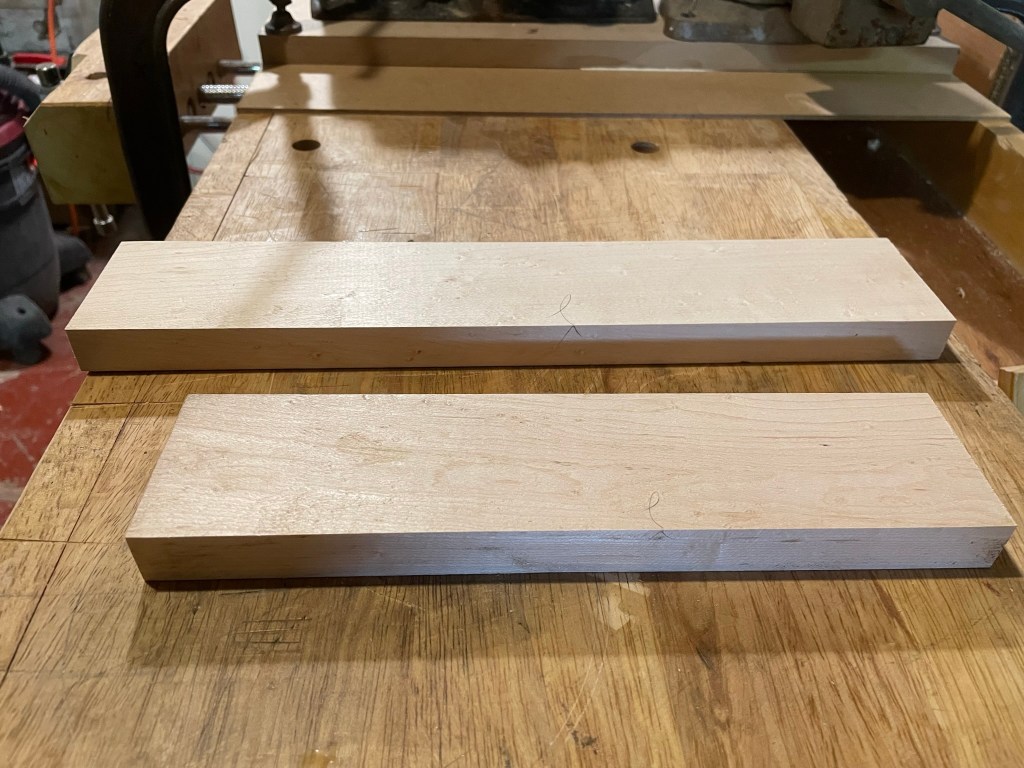
Dimensions of a shooting board vary by the material at hand, the purpose of the operation (miters, end grain, long grain), and should be based on the typical lumber used in projects. This shooting board is intended mostly for trimming end grain, though it could be used for long grain shooting on smaller pieces.
The cleats on the top and bottom of the board are made of maple offcuts from the Outlet Extender project. Using harder wood here (rather than something like pine) limits the grain compression, resulting from the repeated impacts, and subsequent deformation away from square.
The laminated base includes one layer of 1/8″ hardboard for the plane track, and one layer of 3/4″ MDF to lift the workpiece into the depth of the plane. The MDF also provides a rail against which the plane can slide for horizontal reference.
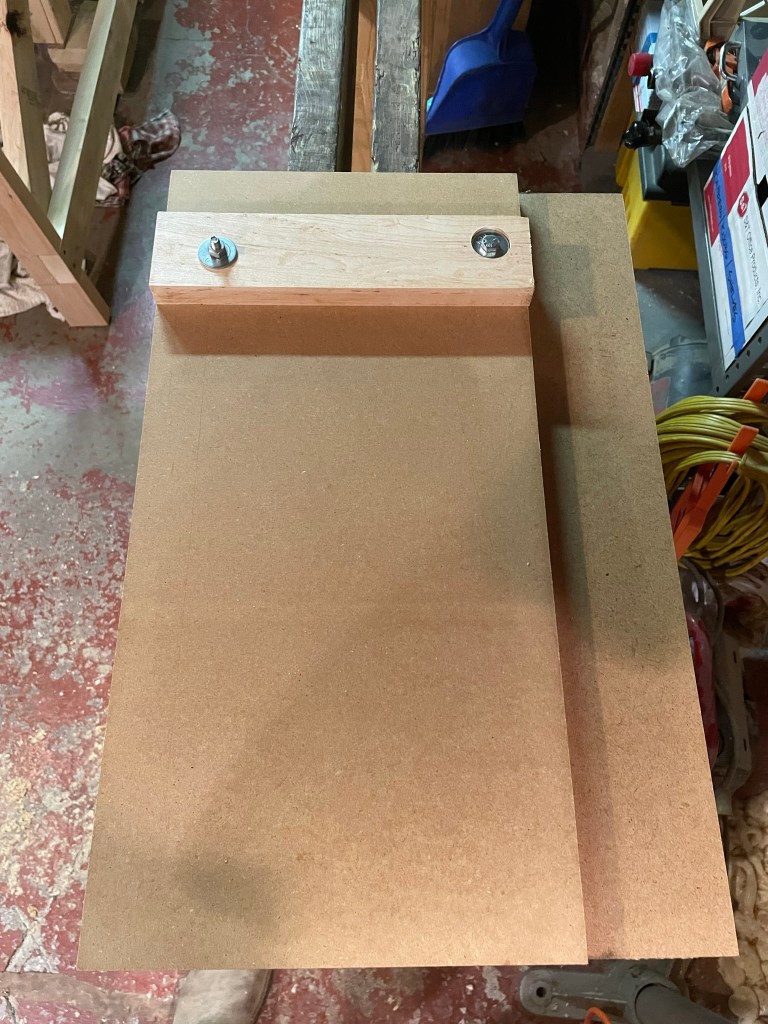
The top cleat is sometimes set into a dado in the top of the base, mechanically locking the cleat into square. This must be done accurately, of course, as it cannot be easily changed later without some fiddling with tape or shims between the workpiece and the cleat. Rather than locking the cleat into the set position (and creating more pressure for myself to execute a very accurate dado), I’ve instead included two bolts through the cleat to allow some adjustment back to square. The hole nearest the plane track is sized for a tight fit around the bolt and is meant only to pivot for adjustments. The bolt used at this connection is a smooth shank through the depth of the cleat and over the interface with the base. Had I used a fully threaded bolt, I think the reduced bearing area at the ridges of each thread would more readily compress the wood (or adhesive matrix in the MDF) resulting in a loose pivot point within the fence. That’s undesirable. The hole at the opposite end of the cleat is oversized to allow slight adjustments of the cleat, rotating about the sister bolt. A nylon nut is on there for now, but will upgrade this to a wing nut or knob with a lock washer for easier adjustment.
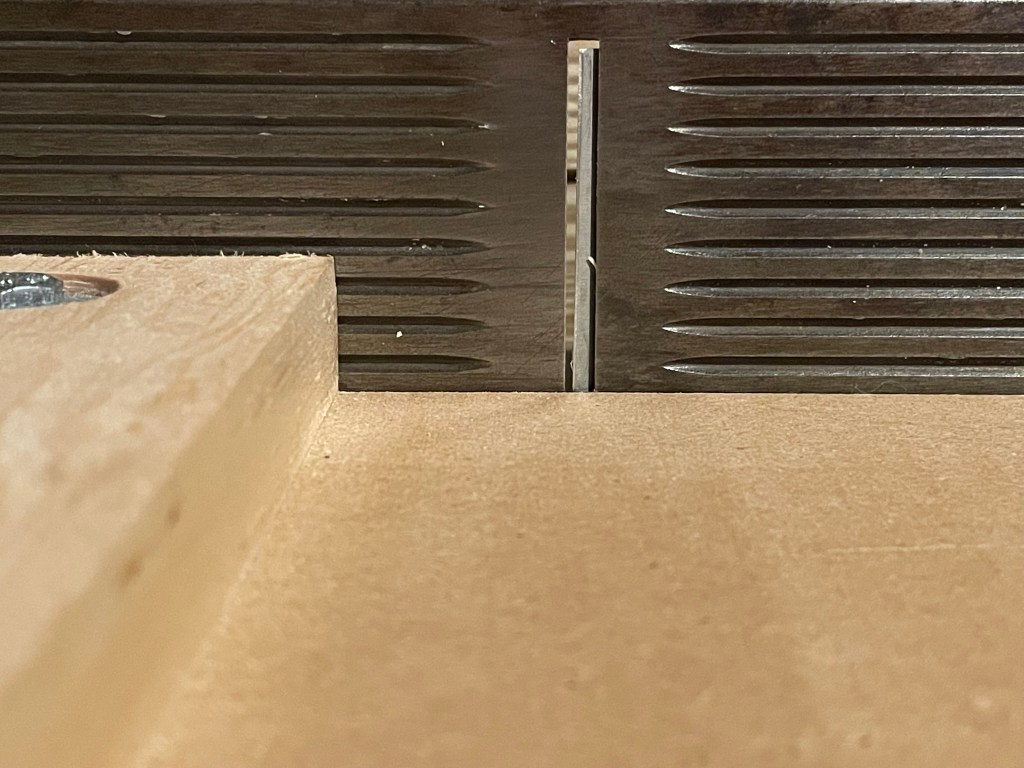
I am already seeing the benefit of having a shooting board during my shop time. No longer am I sweating about ‘perfect’ cross cuts, nor do I have to rely on arduous sanding to achieve that deep and silky end grain finish. This first iteration is working well and I look forward to continuing to build up my hand tool workflow.
 Charles R. Vermace